

English below
En 2022 me invitaron a impartir una conferencia en unas jornadas de transformación e innovación digital organizadas por la American Chambers de Monterrey, México. Yo era el único que parecía no encajar, pero todo lo contrario. Sin saberlo, me convertí en el transmisor del tema clave para que cualquier transformación sea exitosa al empezar diciendo que “la verdadera innovación reside en la humanización del trabajo”.
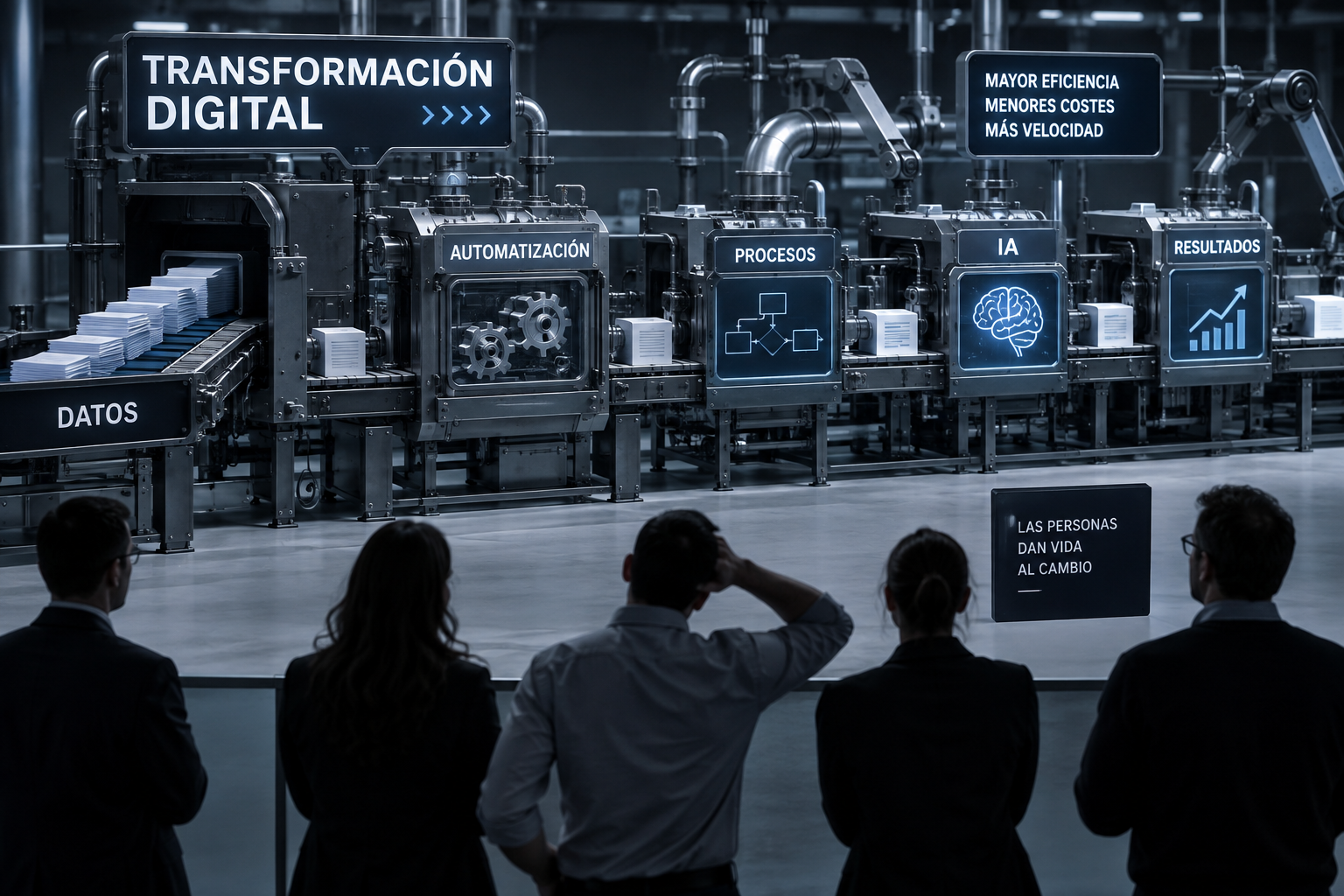
Toda transformación, incluso la más revolucionaria de los últimos tiempos como es la de la Inteligencia Artificial, no deja de ser eso, un cambio del estado de la técnica que modifica comportamientos y formas de hacer las cosas. Para que dichos cambios se culminen siempre tenemos dos opciones: la primera, que la transformación sea impuesta forzosamente. Probablemente se logre a largo plazo, pero el proceso habrá sido doloroso, el desgaste, extremo, la resistencia habrá sido titánica y, en términos empresariales, habremos dejado muchos cadáveres por el camino, lo que afecta a las finanzas, a la cultura y a la reputación. Y la segunda, que la transformación sea llevada a cabo por las personas que dan vida a la organización, poniéndolas en el centro de la ecuación, habiéndolas partícipe de lo que ocurre para que la abracen y sean ellas quienes la llevan a cabo.
Esta segunda es la que garantiza una transición exitosa, es la que refuerza la cultura, es la que consolida un modelo empresarial fuerte y duradero. Es la que, en definitiva, nos permite extraer todo el jugo de la transformación que buscamos; esto es lo que vamos a ver.
Empecemos por el principio preguntándonos qué hemos de tener en cuenta para afrontar un proceso de transformación digital.
En primer lugar, la tecnología en sí misma, todo lo que tenga que ver con sistemas, IA, automatización, datos o herramientas a implementar. En segundo lugar, los procesos que se verán afectados y los que tendremos que modificar o implementar, como flujos de trabajo, toma de decisiones, coordinación interdepartamentales o relación con clientes. Por último, las protagonistas de esta historia, las personas, quienes verán afectados sus roles, hábitos, competencias y comportamientos.
Ante esta tríada, solemos caer en el error de poner el foco en el primer y segundo aspectos, olvidando el tercero, el que, precisamente, garantiza el éxito de la transformación que buscamos acometer. Aquí es donde aparece la famosa “adopción” del cambio, que no es otra cosa que preservar el proceso de transformación humana para que suceda la transformación técnica. No podemos obviar que según el Future of Jobs Report 2025, publicado en el World Economic Forum se puso de manifiesto que el 39% de las competencias actuales cambiarán o quedarán desactualizadas entre 2025 y 2030 y que 6 de cada 10 empresas identifica la brecha de habilidades como una barrera principal para su transformación.
La transformación humana responde a comprender el porqué de lo que quiere adoptarse, aceptar la incertidumbre de un nuevo proceso desconocido, con un destino que no todos pueden visualizar pero sobre el que cabe creer. También implica aprender, que no desaprender, idea que escucho a menudo pero que no acabo de compartir, porque soy firme convencido de que todo lo que has aprendido puede servirte de alguna forma para tu futuro, aunque ese aprendizaje te lleve a concluir que lo que hacías ya no sirve. La transformación humana cambia la forma de hacer las cosas, la manera de colaborar y, muy importante, a hacernos cargos de dichos cambios de forma individual, asumiendo nuestra parte de responsabilidad en el proceso. Justamente, sentir que somos responsables nos empodera, nos hace sentir protagonistas y, en consecuencia, nos hace sentir que la transformación tiene una parte de nosotros en ella.
Ahora, la pregunta del millón de dólares, Antonio. ¿Cómo lo llevo a cabo?
Siguiendo un sencillo modelo de 4 pasos y aprendiendo las 8 capacidades humanas clave para todo cambio sustancial, las que trabajamos en nuestro Programa Ejecutivo de Felicidad Eficiente y de Transformación. Paso a continuación a desglosártelo:
Empecemos por el modelo.
- Preparar. Significa entender el impacto humano del cambio, tener conversaciones, prever situaciones y contingencias, estar preparados para lo que pueda venir, aunque sea imprevisible.
- Alinear. Es decir, conectar la transformación con el propósito, el liderazgo y la cultura, en otras palabras, dar significado a referida transformación, respondiendo al porqué de la organización de una forma que sea coherente con los valores y que respete nuestra forma de liderar.
- Activar. Esto es dar vida a la transformación, entrenando comportamientos y capacidades para adoptar el cambio de la forma más conveniente para cada colectivo afectado.
- Consolidar. Implica asegurar el cambio, no quedarnos en la primera capa sino trabajar por la durabilidad que buscamos a través del acompañamiento, medición y seguimiento para convertirlo en la nueva forma de trabajar.
Hasta aquí, todo puede resultarte familiar, un clásico modelo de change management o gestión del cambio, sin confundir que la transformación no piden solo de gestión comunicativa, sino de entrenamiento real para que sucedan y se consoliden. Y en ello, precisamente, nuestras 8 capacidades adquieren el protagonismo que merecen. ¿Cuáles son estas capacidades humanas?
- Coherencia personal.
Podemos querer construir la mejor empresa del mundo a través de las transformaciones que queremos, partiendo de una buena base para ello. Sin embargo, si mis colaboradores, o yo mismo, no estamos alineados con lo que estamos haciendo, perdemos el sentido, la coherencia y el compromiso y, todo lo que construyamos, caerá en saco roto.
- Hacer lo correcto.
En toda transformación afrontaremos dilemas que no nos habíamos planteado que pueden poner en juego nuestra integridad. Atrevernos a hacer lo correcto sin renunciar a nuestros principios (y a la legalidad) es lo que consolidará la confianza en el proceso, es lo que enviará un mensaje al resto de cuál es el camino adecuado a seguir.
- Cuidado real.
El viaje de la adopción de la transformación necesita de un equipo cohesionado y conectado, en el que las personas de forma genuina se cuiden entre ellas para que todo salga. Cuando uno no tenga fuerza, el de al lado tirará más y cuando éste sea a quien le flaqueen, el primero agarrará las riendas. El hoy por ti y mañana por mí clásico, siempre, como un mantra. Eso se logra con confianza y seguridad psicológica.
- Autorresponsabilidad y actitud de servicio.
La dificultad del cambio pide a gritos que nos hagamos responsables de nuestros actos, que nos comportemos como adultos reales que buscan solución a los problemas que surgen por el camino. Asimismo, la actitud de servicio posiblemente sea la capacidad más relevante en todo lo que estamos viendo. Es esa habilidad de estar siempre disponible, de no buscar culpables, de ocuparnos de todo lo que no se nos pide porque siento que es lo correcto. Ese ejemplo, además, arrastra al resto y permite que la adopción sea más sencilla.
- Diálogo y empatía.
Las habilidades humanas más importantes y, quien sabe, si las más infravaloradas. El diálogo tiene como base la escucha para la comprensión, sin juicio previo, solo con la voluntad de entender la postura del otro. Eso es importantísimo en un proceso de transformación, ya que nuestros prejuicios ante las distintas situaciones que se van dando pueden nublarnos el camino al cambio, pueden llevarnos a conclusiones erróneas fruto de lo que nos contamos, cuando la mayoría de veces ese discurso interno está alejado de la realidad de los hechos. Por ello, aprender a escuchar y aprender a transmitir revisten como capacidades infalibles en toda transición, en donde, cómo no, la empatía generará mayores vínculos y suavizará las tensiones eventuales.
- Resiliencia.
Ante lo incierto y los errores acaecidos siempre tenemos dos opciones. Quejarnos, lo que no sirve para nada y consume una gran cantidad de energía a través de una frustración inútil que no cambiará lo ocurrido, o plantearnos cómo poder seguir adelante a pesar de las dificultades. Un proceso de transformación va a tener momentos de ensayo y error. Ojalá no fuera así, pero la experiencia me ha enseñado todo lo contrario. La resiliencia no es dejarse aplastar por los cambios, sino es poner en práctica la empatía hacia nosotros mismos, escuchándonos para comprendernos y darnos el apoyo para salir adelante.
- Cultivar la esperanza sin ser víctima de las expectativas.
Para mantener la energía que te impulse a un lugar necesitas un motivo en el que creas, ahí reside la esperanza. Se dice que la esperanza es un sentimiento o estado de ánimo pero yo diría que es más una herramienta a través de la cual trazamos una visión y el plan para alcanzarla. Suele venir en forma de fuerza interna que se ve favorecida por las conexiones positivas con nuestros pares y que nos recuerda que depende de nosotros conseguir lo que nos proponemos. Tal vez el resultado obtenido no sea como esperamos, tal vez implique cambiar el guión radicalmente por el camino, pero siempre va a depender de nosotros. Esto es lo que la diferencia de las expectativas, que dependen de terceros que no podemos controlar y sobre los que no tenemos poder de actuación.
- Valores y propósito.
Si antes veíamos la importancia de la coherencia personal, ahora abordamos la importancia de la coherencia empresarial para adoptar dicho cambio. Una gran tecnología para el mercado no necesariamente tiene que ser buena para nosotros si menoscaba nuestra de dar vida al negocio, con el siguiente ejemplo de uno de nuestros clientes lo verás. Un hotel cuya máxima era “hacerte sentir en casa” se planteó agilizar el proceso de check-in informáticamente para que el huésped fuera directamente a su habitación sin tener que pasar por ninguna recepción. No obstante, lo acabaron frenando porque no iba ni con su forma de hacer las cosas ni en como entendían el negocio. No iban a deshumanizar un proceso que les parecía fundamental, como es la bienvenida en calidad de grandes anfitriones. Eso es coherencia y es nuestra brújula para la adopción del cambio.
Estas capacidades, constantes en el modelo, tienen como objetivo superar la resistencia natural que acompaña a toda transformación, transicionando del “me han cambiado la empresa” a “yo formo parte del cambio”, superando las etapas de resistencia, comprensión, implicación y adopción, cuando ya lo hacemos nuestro.
Para finalizar, no podemos dejar de lado que este proceso no puede trabajarse igual con todos los colectivos de la organización, ya que cada uno desempeña su papel. Para hacerlo simple, distinguiremos en que la dirección ha de dar sentido, visión, coherencia, ejemplo y confianza, hacer sentir a los demás que hay alguien al volante. Los managers son los que convierten la estrategia y visión del cambio en comportamientos ejecutables por parte de sus equipos, lo que les lleva a saber explicar, escuchar, detectar resistencias, dar feedback constante, acompañar y liderar en la pantanosa incertidumbre. Por último, los equipos son quienes ejecutan dicho cambio, quienes, en definitiva, le dan vida, para lo que han de aprender, preguntar, cuestionar, se han de implicar, han de experimentar, colaborar y han de autorresponsabilizarse.
Recuerda que el objetivo no es el cambio en sí mismo. Es que la organización se transforme con dicho cambio, lo que solo sucede cuando las personas lo hacen suyo, lo comprenden, cuando reducen las fricciones, cuando se sienten empoderadas, cuando el liderazgo acompaña y cuando entre todos colaboramos para que así sea.
Porque como nos confirmaron las mejores prácticas en change management de Prosci, una gestión excelente del cambio multiplica por 7 la probabilidad de alcanzar los objetivos del proyecto, para lo que, sin duda, las personas son el denominador común del éxito.
Feliz día.
Antonio Rodríguez Martínez
Orgulloso fundador y director de Efficient Happiness
PD: si necesitas que te ayudemos en la gestión del cambio o en la adopción de tus procesos de transformación empresarial, tan solo tienes que escribirnos y examinaremos tu caso encantados.
Digital Transformation. Human Transformation.
In 2022, I was invited to give a conference at a digital transformation and innovation event organized by the American Chamber of Commerce in Monterrey, Mexico. I was the only one who seemed out of place, but quite the opposite was true. Without realizing it, I became the messenger of the key to making any transformation successful when I opened by saying that “true innovation lies in making work more human.”
Every transformation, even the most revolutionary one of recent times, such as Artificial Intelligence, is ultimately just that: a technological change that modifies behaviors and the way we do things. For these changes to be fully implemented, we always have two options: the first is to impose transformation by force.
It will probably be achieved in the long term, but the process will have been painful, the exhaustion extreme, and the resistance enormous. In business terms, we will have left many casualties along the way, affecting finances, culture, and reputation.
And the second option is for the transformation to be carried out by the people who bring the organization to life, placing them at the center of the equation, involving them in what is happening so that they embrace it and become the ones who carry it out.
This second option is what guarantees a successful transition, strengthens the culture, and consolidates a strong and lasting business model. Ultimately, it is what allows us to get the most out of the transformation we are seeking. This is what we are going to explore.
Let’s start at the beginning by asking ourselves what we need to consider when undertaking a digital transformation process.
First, technology itself: everything related to systems, AI, automation, data, or the tools to be implemented. Second, the processes that will be affected and those we will need to modify or implement, such as workflows, decision-making, interdepartmental coordination, or customer relationships. Finally, the protagonists of this story: people, whose roles, habits, skills, and behaviors will be affected.
Faced with these three elements, we often make the mistake of focusing on the first and second aspects, forgetting the third, which is precisely what guarantees the success of the transformation we seek to undertake. This is where the well-known concept of change “adoption” comes into play, which is nothing more than ensuring that the human transformation process takes place so that technological transformation can happen.
We cannot ignore the fact that, according to the Future of Jobs Report 2025, published by the World Economic Forum, 39% of current skills will change or become outdated between 2025 and 2030, and that 6 out of 10 companies identify the skills gap as a major barrier to their transformation.
Human transformation involves understanding why we want to adopt something, accepting the uncertainty of a new and unfamiliar process, with a destination that not everyone can visualize but in which we must believe. It also involves learning, not unlearning, an idea I often hear but do not entirely agree with, because I firmly believe that everything you have learned can serve you in some way in the future, even if that learning leads you to conclude that what you used to do is no longer useful.
Human transformation changes the way we do things, the way we collaborate, and, very importantly, encourages us to take individual ownership of these changes, assuming our share of responsibility in the process. Precisely, feeling responsible empowers us, makes us feel like protagonists and, consequently, makes us feel that the transformation has a part of ourselves in it.
Now comes the million-dollar question, Antonio. How do I make it happen?
By following a simple four-step model and learning the eight key human capabilities for any substantial change, the ones we develop in our Efficient Happiness Executive and Transformation Program. Let me break it down for you:
Let’s start with the model.
1. Prepare. This means understanding the human impact of change, having conversations, anticipating situations and contingencies, and being prepared for whatever may come, even if it is unpredictable.
2. Align. In other words, connecting transformation with purpose, leadership, and culture. This means giving meaning to that transformation, answering the organization’s “why” in a way that is consistent with its values and respects our way of leading.
3. Activate. This means bringing transformation to life, training behaviors and capabilities to adopt change in the most appropriate way for each group affected.
4. Consolidate. This involves securing the change, not stopping at the first layer but working toward the long-term sustainability we seek through support, measurement, and follow-up, turning it into the new way of working.
So far, all this may sound familiar to you: a classic change management model. However, we must not confuse transformation with communication management alone. Transformation also requires real training for changes to take place and become consolidated. And this is precisely where our eight capabilities take on the importance they deserve. What are these human capabilities?
1. Personal consistency.
We may want to build the best company in the world through the transformations we seek, starting from a solid foundation. However, if my colleagues, or even I myself, are not aligned with what we are doing, we lose our sense of purpose, consistency, and commitment, and everything we build will be in vain.
2. Doing the right thing.
In every transformation, we will face dilemmas we had never considered before, which may put our integrity at stake. Having the courage to do the right thing without compromising our principles (or the law) is what will strengthen trust in the process and send a message to everyone else about the right path to follow.
3. Genuine care.
The journey toward adopting transformation requires a cohesive and connected team in which people genuinely care for one another to ensure that everything works out. When one person lacks the strength, the person next to them will pull harder, and when that person is the one whose strength begins to fail, the first will take the reins.
The classic “today for you, tomorrow for me,” always, like a mantra. This is achieved through trust and psychological safety.
4. Personal accountability and a service mindset.
The challenges of change demand that we take responsibility for our actions, that we behave like mature adults who seek solutions to the problems that arise along the way. Likewise, a service mindset is possibly the most relevant capability of everything we are discussing. It is that ability to always be available, not to look for someone to blame, and to take care of everything that is not asked of us simply because we feel it is the right thing to do.
That example also inspires others and makes adoption easier.
5. Dialogue and empathy.
The most important human skills and, perhaps, the most undervalued. Dialogue is based on listening to understand, without prior judgment, with the sole intention of understanding the other person’s point of view.
This is extremely important in a transformation process, as our prejudices regarding the different situations that arise can cloud our path toward change and lead us to incorrect conclusions based on the stories we tell ourselves, when most of the time that internal narrative is far removed from the reality of the facts.
That is why learning to listen and learning to communicate are essential capabilities in any transition, where empathy will, of course, create stronger bonds and ease any tensions that may arise.
6. Resilience.
Faced with uncertainty and the mistakes that occur, we always have two options. We can complain, which serves no purpose and consumes a great deal of energy through useless frustration that will not change what has happened, or we can ask ourselves how to keep moving forward despite the difficulties.
A transformation process will have moments of trial and error. I wish it were otherwise, but experience has taught me quite the opposite.
Resilience is not about allowing ourselves to be crushed by change, but about putting empathy toward ourselves into practice, listening to ourselves to understand what we are going through and giving ourselves the support we need to move forward.
7. Cultivating hope without becoming a victim of expectations.
To maintain the energy that drives you toward a destination, you need a reason to believe. That is where hope lies. Hope is said to be a feeling or a state of mind, but I would say it is more of a tool through which we create a vision and a plan to achieve it.
It often comes in the form of an inner strength that is reinforced by positive connections with our peers and reminds us that achieving what we set out to do depends on us.
Perhaps the result we obtain will not be what we expected. Perhaps it will mean radically changing the plan along the way, but it will always depend on us. This is what distinguishes hope from expectations, which depend on third parties we cannot control and over whom we have no power to act.
8. Values and purpose.
If we previously explored the importance of personal consistency, we will now address the importance of organizational consistency in adopting change. A technology that is excellent for the market does not necessarily have to be good for us if it undermines our way of bringing our business to life. The following example from one of our clients illustrates this.
A hotel whose guiding principle was to “make you feel at home” considered streamlining its check-in process through technology so that guests could go directly to their rooms without having to stop at reception. However, they ultimately decided against it because it did not fit with their way of doing things or their understanding of the business.
They were not willing to dehumanize a process they considered fundamental: welcoming guests as excellent hosts.
That is consistency, and it is our compass for adopting change.
These capabilities, which remain constant throughout the model, aim to overcome the natural resistance that accompanies every transformation, moving from “they have changed my company” to “I am part of the change,” progressing through the stages of resistance, understanding, involvement, and adoption, when we finally make the change our own.
Finally, we cannot overlook the fact that this process cannot be approached in the same way with every group within the organization, as each has its own role to play.
To keep things simple, we will distinguish between senior leadership, which must provide meaning, vision, consistency, example, and trust, making others feel that someone is at the wheel.
Managers are the ones who turn the strategy and vision behind the change into behaviors that their teams can put into practice. This requires them to know how to explain, listen, identify resistance, provide continuous feedback, offer support, and lead through the murky waters of uncertainty.
Finally, teams are the ones who execute that change, the ones who ultimately bring it to life. To do so, they must learn, ask questions, challenge assumptions, get involved, experiment, collaborate, and take personal responsibility.
Remember that the goal is not change itself. It is for the organization to transform through that change, something that only happens when people make it their own, understand it, when friction is reduced, when they feel empowered, when leadership provides support, and when we all collaborate to make it happen.
Because, as Prosci’s best practices in change management have confirmed, excellent change management makes projects seven times more likely to achieve their objectives, and people are undoubtedly the common denominator of success.
Have a great day.
Antonio Rodríguez Martínez
Proud Founder and CEO of Efficient Happiness
P.S. If you need us to help you with change management or the adoption of your business transformation processes, just write to us and we will be delighted to discuss your situation.